Piano Tuning, Service & Repair
Regular piano tuning and professional maintenance are essential to keeping your instrument performing at its best. I provide piano tuning, regulation, repair, and service for Steinway & Sons and other fine pianos, with careful attention to tone, touch, stability, and the individual needs of each instrument.
A piano is a complex mechanical instrument, and tuning alone does not address every aspect of its performance. Over time, changes in felt, leather, wood, and other action components can affect the way the piano responds and sounds. Periodic regulation, voicing, and maintenance help preserve an even touch, consistent tone, and reliable performance.
Tuning
Regular tuning is essential to maintaining a piano’s stability, tone, and musical performance. How often a piano should be tuned depends on how frequently it is played, its environment, and the expectations of the pianist.
For most home pianos, I generally recommend tuning at least once or twice a year. Pianos used heavily for teaching, performance, churches, schools, or other professional settings may require more frequent service.
Each tuning is approached with the individual instrument in mind, with attention not only to pitch but also to stability, temperament, and the overall musical character of the piano.
Voicing (Tone Regulation)
Voicing is the process of shaping and refining a piano’s tone. Over time, hammer felt compresses and wears, which can cause the tone to become overly bright, harsh, uneven, or lacking in color.
Through careful voicing, the hammers can be adjusted to produce a more balanced and even tone throughout the entire keyboard while preserving the individual character of the instrument.
Voicing is not simply about making a piano brighter or mellower. The goal is to give the pianist a wider range of tonal color and greater control, from the softest pianissimo to a powerful fortissimo.
Action Regulation
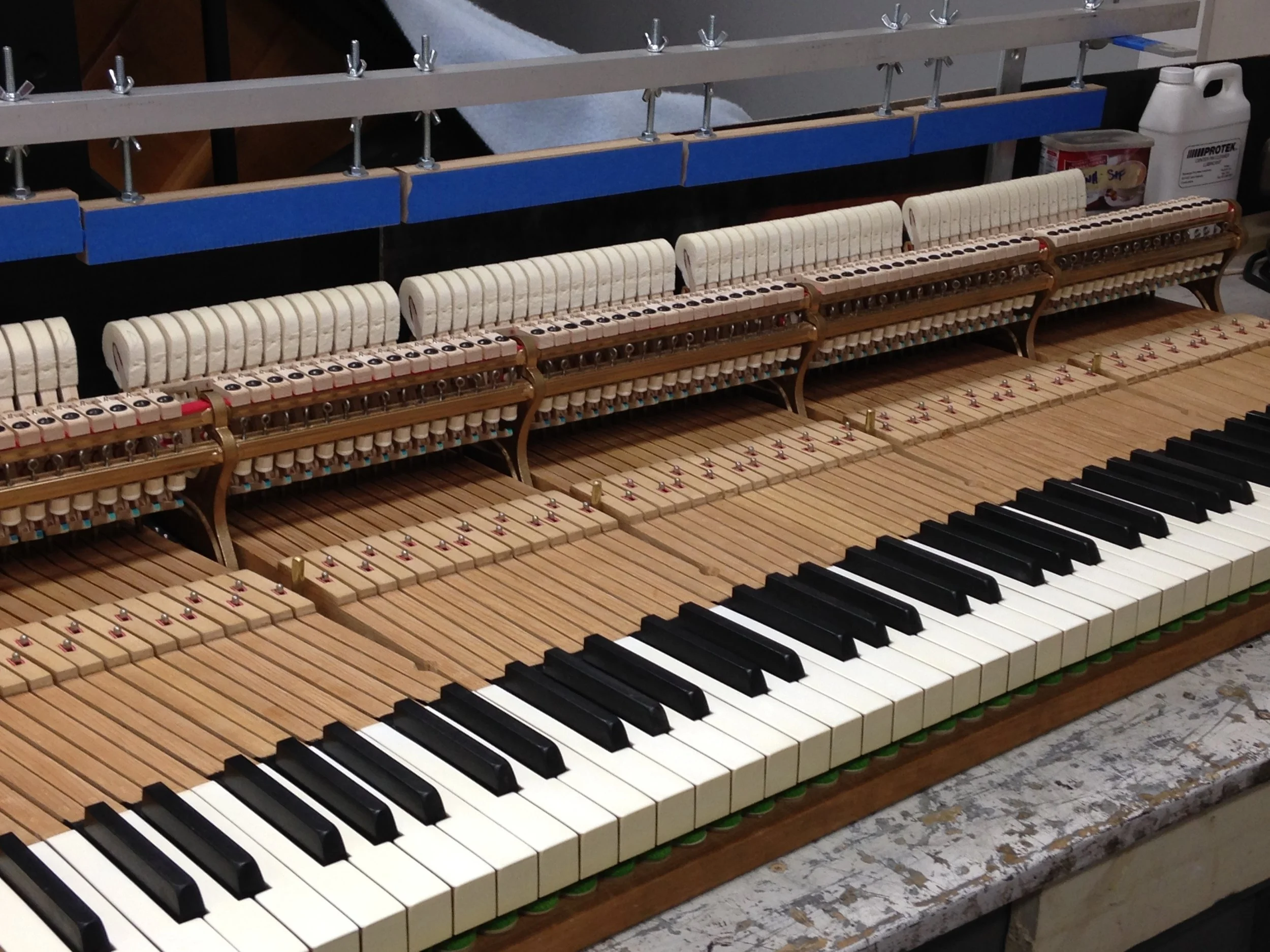
Action regulation is the precise adjustment of the piano’s mechanical components so that the keyboard and action respond evenly, predictably, and efficiently to the pianist. Over time, normal wear, compression of felt and leather, and changes in wooden components can alter these critical adjustments.
A properly regulated action provides better repetition, greater control at soft dynamics, more consistent touch from note to note, and allows the pianist to use the full expressive range of the instrument. Regulation can also address an action that feels heavy, light, sluggish, uneven, or simply less responsive than it once did.
When appropriate, regulation can also include evaluation of action geometry and touchweight to improve the relationship between the pianist and the instrument rather than simply adjusting the action to a set of measurements.
Repairs and Restoration
As a piano ages, normal wear can gradually affect its tone, touch, stability, and overall performance. In many cases, individual components can be repaired or replaced without the need for a complete rebuilding.
Repairs may range from correcting mechanical problems and replacing worn action parts to more extensive work involving strings, pinblocks, bridges, soundboards, and other structural components.
Each piano is evaluated individually. The appropriate level of work depends on the condition and quality of the instrument, how it will be used, and the expectations of the owner. My goal is to recommend only the work necessary to return the piano to dependable, satisfying musical performance
Following an evaluation, I can recommend a course of work appropriate to the instrument—from individual repairs and reconditioning to a more comprehensive restoration.
Contact John Butler, RPT today to schedule an appointment
301.262.1595 | butlerandsonspiano@gmail.com